
Never underestimate Hong Kong people. Especially their English skills.
A few months ago, I watched the Hong Kong episode of Anthony Bourdain's No Reservations, in which he accompanies a local food blogger to a Yau Ma Tei restaurant known for its clay pot rice, "a local winter specialty." It's referred to as comfort food among the rice-loving populace here, and that's all fine and dandy, except...
The blogger spoke in that most Hong Kong of accents, emphasizing each syllable, tone rising and falling with each break of the word, in a manner that would make Russel Peters proud. Like this: LO-co WIN-ter SPE-sul-TEE.
I pointed at the screen and laughed. I wasn't alone! Even the producers had felt compelled to add subtitles whenever he talked.
Fast forward to about a week ago, and I'm in Hong Kong, already tired of canteen food. Having lost the will to eat, I visit my favorite Hong Kong food blog, Cha Xiu Bao, in search of some gastronomic inspiration.
Cha Xiu Bao is a fascinating blog, replete with amusingly random post titles ("Lover's Tears - Heartbreak Sour & Spicy Noodles") and expertly shot hi-res food porn. It's Chinese through and through, with English translations of ancient Chinese food wisdom everywhere. Forgive me if I sound a bit too book review-ish here, but its combination of cultural insight, food knowledge, and caustic humor is simply... unparalleled.
One of the posts I stumble across while trying to whet my appetite involves Cha Xiu Bao's interview with CNN, in which he questions the Michelin Guide for awarding one of its coveted stars to a grungy local dim sum joint, Tin Ho Wan. I click on the attached video clip, and a few minutes in -- to my surprise -- is a very skeptical Mr. Clay Pot Rice, accent and all, talking about Tin Ho Wan. Cha Xiu Bao is Mr. Clay Pot Rice!


Then it hit me: just because Hong Kongers pronounce English words differently than we do, doesn't mean they can't speak or comprehend English at all! Cha Xiu Bao, who is actually Josh Tse, may in fact have a funny accent, but judging by the quality of his blog, he is also a brilliant writer. It's the same story in the classrooms here at the Chinese University of Hong Kong: you have students who've never even left the boat expressing profound thoughts in this second language of theirs. If only I could do the same with my first.
Anyhow, seeing Mr. Tse on my screen triggered an immediate craving for Hong Kong's winter specialty, and with my appetite thus restored, I went off in search for some clay pot rice.

Bourdain went to a restaurant called Four Seasons Claypot Rice, and in truth, I wanted to go there as well, just so I could follow in the footsteps of my favorite Travel Channel celebrity. But the realities of eating in a large group meant that wouldn't be possible, so instead, we chose a nearby restaurant on Temple Street with a much shorter line. Slight disappointment aside, there's something to be said for the joys of spontaneity and improvisation; the meal turned out to be wonderful.
Our restaurant, which doesn't have an English name -- not that it needs one, as trying to find this exact joint having read a review would be missing the point -- was a mix of the ordinary and extraordinary. On one hand, there was the usual cacophony of clattery chopsticks, the claustrophobia of too many tables in too small a place, and the general pain and discomfort of using folding stools as chairs. But we were also assaulted by expert, unashamed predatory salesmanship in the form of a hyper-enthusiastic beer saleslady, who had been eying our large group of diners in anticipation of a mega commission. Cha-ching! Unfortunately for her, we went with hot tea.
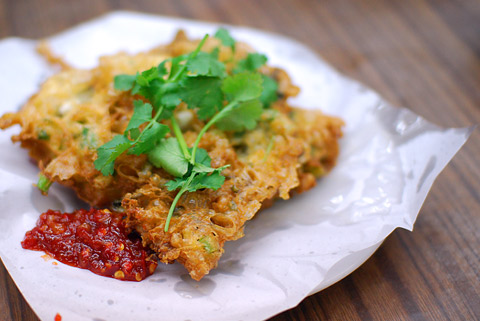
Sorry, I neglected to do close-ups of the food. This pic is borrowed from LastAppetite.com.
Oyster Omelette
First up was this sinfully fried oyster omelette of sorts. The service here is so brisk that the omelette arrived -- crashing down on the table, dish already pooling with oil -- well before we'd even finished ordering. As expected from anything battered, deep fried and abundant in cholesterol, it was delicious, a savory, tongue-tingling endorphin rush on a plate. Food like this isn't meant to be eaten politely or analyzed carefully; it's about satisfying a crave with excesses and bold flavors. This is instinctive food. Eat too slowly and it'll be gone.
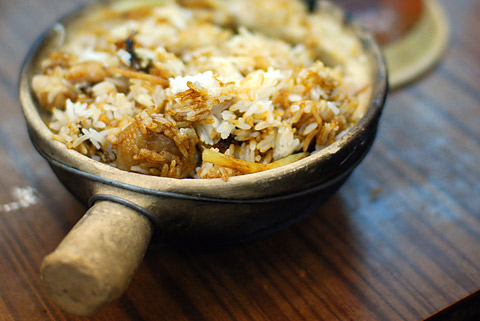
Also from of LastAppetite.com.
Next up is what I came to Temple Street for. Essentially it's rice baked in a clay pot over extremely hot charcoal, enhanced by the addition of a few toppings: usually, Chinese sausage, preserved duck, spare ribs, or salt fish and chicken. The hot and steamy environment of the pot has the salt and fat mingling with the plain and starchy, which imparts an unexpected sense of subtlety and wholesomeness to each bite. What could possibly be better than a warm, flavorful blanket of rice? The crunchy, burned bits underneath.
We also ordered baby bak choy, tong choy, and clams with black bean sauce, all done in the traditional Cantonese stir-fried idiom. They were perfect complements to the rice.

Finished with eating, we headed back to the streets, fending off intrusive street vendors each peddling essentially identical pieces of crap: "Hansum boy, come here, best price, buy, you want???" Strolling past the fake Maglite flashlights, the genuine fake watches, and the range of phallus shaped items, it seemed to me that Temple Street is now way more about cheap food than cheap trinkets. And what an incredibly satisfying cheap meal that was.
Cha Xiu Bao
Skip to 3:00 for Four Seasons Claypot Rice:


No comments:
Post a Comment